
Choosing a management course after graduation can be confusing, especially when two of the most popular options—PGDM and MBA—appear quite similar. Both programs prepare students for careers in management, marketing, finance, human resources, operations, consulting, and entrepreneurship. However, the way these programs are structured and delivered can be different.
For students planning a career in business and management, understanding the PGDM vs MBA difference is important before making an admission decision. Instead of simply asking which course is better, students should think about their career goals, preferred learning style, specialization, institution quality, placements, and long-term plans.
Here is a simple guide to help you understand PGDM and MBA and decide which option may suit you better.
What is PGDM?
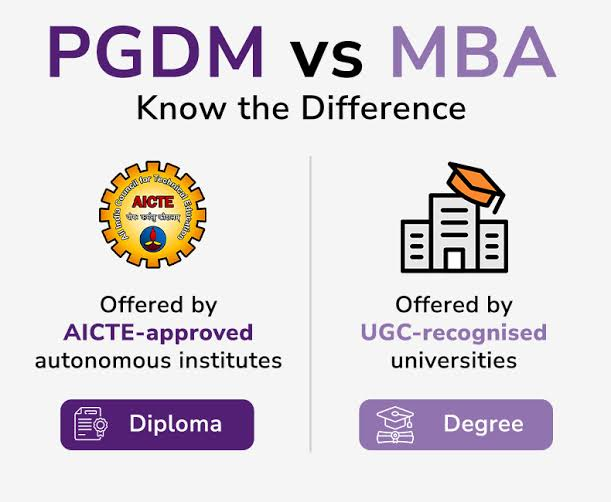
PGDM stands for Post Graduate Diploma in Management. It is generally offered by autonomous management institutions rather than universities.
One of the major attractions of a PGDM program is its industry-oriented approach. Autonomous institutions often have greater flexibility in updating their curriculum according to changing business requirements. As a result, students may get exposure to emerging areas such as business analytics, digital marketing, artificial intelligence in business, financial technology, entrepreneurship, and data-driven decision-making.
PGDM programs commonly combine classroom learning with case studies, presentations, internships, workshops, industry interactions, group projects, and live assignments.
This makes PGDM particularly attractive to students who prefer practical learning and want regular exposure to real business situations.
What is an MBA?
MBA stands for Master of Business Administration. Unlike PGDM, an MBA is a postgraduate degree awarded by a university or an institution authorized to award degrees.
MBA programs usually provide students with a strong foundation in business and management concepts. Students study subjects such as marketing management, financial management, organizational behaviour, human resource management, operations, business strategy, economics, and entrepreneurship.
The exact curriculum and teaching approach can vary significantly between universities and colleges.
An MBA can be a suitable option for students who want a recognized postgraduate degree while developing a broad understanding of different areas of business management.
PGDM vs MBA: What Is the Main Difference?
The most basic difference between PGDM and MBA is the type of qualification awarded.
An MBA is a degree, whereas a PGDM is a diploma offered by an autonomous institution. However, students should not judge the quality of a management program simply because one is called a degree and the other a diploma.
The reputation of the institution, approvals and recognition, faculty, curriculum, internships, industry connections, alumni network and placement opportunities can have a major impact on the actual value of either program.
Another important difference can be curriculum flexibility.
PGDM institutions may be able to modify their syllabus more frequently, allowing them to introduce subjects based on current industry trends. MBA programs follow the academic structure of their respective universities, although many modern universities also update their programs regularly.
Eligibility for PGDM
PGDM eligibility differs from one institution to another. Generally, candidates are expected to have completed a bachelor’s degree from a recognized institution.
Many management institutes consider scores from entrance examinations such as:
- CAT
- MAT
- XAT
- CMAT
- Other accepted management entrance examinations
Institutions may also conduct further selection rounds such as personal interviews, group discussions or aptitude assessments.
Academic performance, communication ability and overall candidate profile may also be considered during admission.
Students should always check the official eligibility requirements of their preferred institution before applying.
Eligibility for MBA
MBA admission requirements are also broadly similar.
Candidates generally need a bachelor’s degree from a recognized university or institution. Depending on the college or university, students may also need to appear for national, state-level or university-specific management entrance examinations.
The selection process can include entrance scores, counselling, group discussions, interviews and academic performance.
Since eligibility and admission procedures vary between institutions, students should verify the latest requirements directly from the university or college they are considering.
Curriculum and Learning Experience
The learning experience is one of the factors students should consider carefully while comparing PGDM vs MBA.
PGDM programs are often designed with a strong focus on practical business exposure. Students may participate in live projects, corporate interactions, internships, simulations and case-study discussions.
MBA programs generally combine management theory with practical learning. The balance between the two depends heavily on the university and institution.
Therefore, instead of assuming that every PGDM is practical and every MBA is theoretical, students should examine the actual syllabus, teaching methodology, internship opportunities and industry exposure of individual colleges.
Popular Specializations in PGDM and MBA
Both programs offer several specialization options. Some of the most popular include:
Marketing: Suitable for students interested in branding, sales, digital marketing, consumer behaviour and market research.
Finance: Covers areas such as corporate finance, investment, banking, financial planning and risk management.
Human Resources: Focuses on recruitment, employee relations, training, organizational development and performance management.
Operations: Suitable for students interested in supply chains, logistics, production, quality management and operational efficiency.
Business Analytics: Combines business decision-making with data analysis and analytical tools.
Students should select their specialization according to their interests and career objectives rather than simply choosing whichever field appears most popular.
Career Opportunities After PGDM
A PGDM can prepare graduates for opportunities across a wide range of industries.
Depending on their specialization and skills, graduates may explore positions such as:
- Marketing Manager
- Business Development Executive
- Financial Analyst
- HR Executive or Manager
- Operations Manager
- Business Analyst
- Sales Manager
- Management Consultant
- Product Executive
PGDM graduates may find opportunities in sectors such as banking, consulting, FMCG, technology, retail, e-commerce, financial services, manufacturing and startups.
Actual job opportunities and salary packages depend on several factors, including the institution, specialization, prior experience, internships, individual skills and prevailing market conditions.
Career Opportunities After MBA
MBA graduates can also build careers across almost every major business sector.
Common career paths include finance, marketing, consulting, human resources, operations, analytics, business development and strategy.
An MBA can also be valuable for people planning to start a business or join a family enterprise. Knowledge of finance, marketing, operations, leadership and strategy can help future entrepreneurs understand how different parts of a business work together.
However, an MBA alone does not guarantee a high-paying job. Practical skills, communication ability, internships, networking and the reputation of the institution can significantly influence career outcomes.
PGDM vs MBA: Which One Has Better Placements?
This is one of the biggest questions students ask while choosing a management program.
There is no simple answer.
Placement opportunities usually depend more on the quality and reputation of the institution than on whether the qualification is called PGDM or MBA.
A strong institution with active corporate partnerships, experienced faculty, internships, skill-development programs and an established placement cell may provide better opportunities than a poorly performing institution regardless of the course title.
Students should therefore check placement reports, recruiter participation, internship opportunities, alumni outcomes and the types of job roles offered before taking admission.
PGDM or MBA: Which One Should You Choose?
Choose a PGDM if you prefer an industry-focused learning environment, practical assignments, live projects and a curriculum designed to respond quickly to business trends.
An MBA may be more suitable if you specifically want a university-awarded postgraduate degree and prefer the academic structure offered by a particular university.
Most importantly, don’t select a program based only on the words MBA or PGDM.
Compare the institution’s recognition, curriculum, faculty, specialization options, placement record, internship opportunities, fees, location and return on investment.
Final Thoughts
The PGDM vs MBA decision should ultimately depend on where you want your management education to take you.
Both programs can help students develop leadership, communication, analytical and business-management skills. The difference lies largely in the structure of the program, awarding institution, curriculum and learning approach.
Before applying, research individual colleges carefully and compare their academics, approvals, industry exposure and placement support.
A good management education is not simply about earning a qualification. It should help you become more confident in solving problems, making decisions, working with people and adapting to the changing business world.
Choose the program that helps you build those abilities while supporting your long-term career goals.
Book your Free consultancy: 9350777177 / https://reliablestudy.com/
– Content Writer and SEO – Riya Singh
All right reserved – Reliable Study / https://reliablestudy.com/
FAQs
Neither is automatically better. The right choice depends on the institution, curriculum, career goals, learning style and placement opportunities.
PGDM stands for Post Graduate Diploma in Management and is generally offered by autonomous management institutions.
Generally, yes. Graduates from different academic backgrounds can apply, subject to the eligibility criteria of the respective institution.
PGDM programs are often designed with strong industry exposure, although many MBA programs also provide internships, projects and practical learning.
Yes. Graduates from both programs can pursue careers in marketing, finance, HR, operations, consulting, analytics, sales and other management fields.