
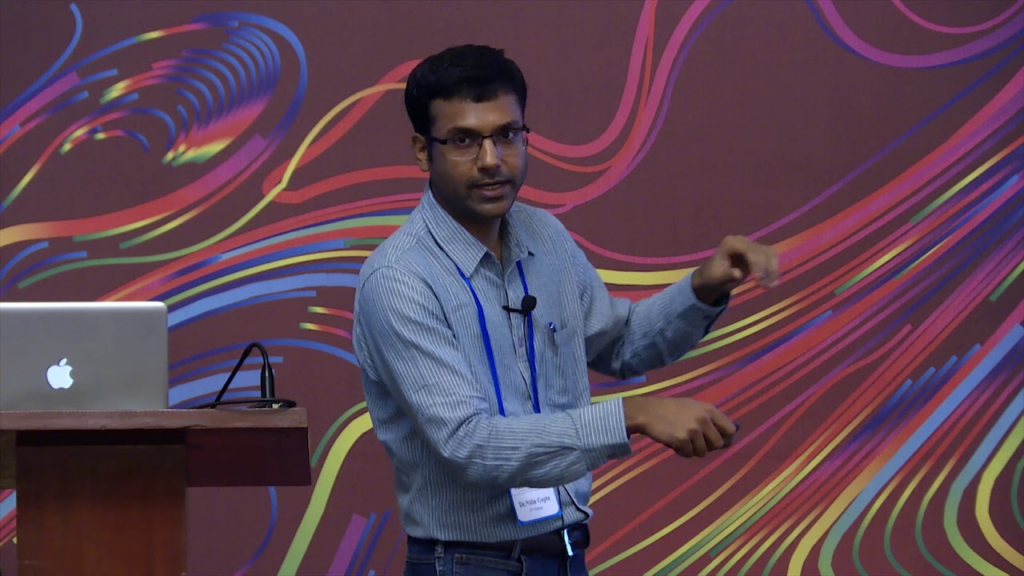
In today’s world, where most students chase high-paying tech jobs and dream packages worth crores, the story of IIT JEE topper Nitin Gupta feels refreshingly different and deeply inspiring. Instead of following the traditional path of engineering → corporate job → high salary, he chose something far more unconventional — understanding the human brain.
His journey from IIT Kanpur to neuroscience is not just about career choice; it is about curiosity, purpose, and the courage to follow passion over money.
🎓 From JEE AIR Rank 1 to IIT Kanpur
Nitin Gupta’s academic journey began with extraordinary success. He secured a top rank in the highly competitive IIT-JEE exam and joined IIT Kanpur, one of India’s most prestigious engineering institutions.
Like many toppers, his early path seemed predictable:
- IIT degree
- High-paying tech job
- Corporate success
But during his time at IIT, something shifted. While computer science gave him strong technical skills, his interest slowly moved beyond coding and systems — toward biology, data, and ultimately the human brain.
This shift would later define his entire career.
🧠 A Shift From Code to Brain Science
After completing his BTech in Computer Science from IIT Kanpur, Nitin Gupta did something unexpected. Instead of joining the corporate tech race, he moved into bioinformatics and computational biology for higher studies.
He pursued advanced research at global institutions, where he explored how:
- Genes translate into proteins
- Biological systems can be modeled using computation
- Complex life processes can be decoded using algorithms
This phase marked the beginning of his transformation from an engineer into a scientist focused on life and brain systems.
🌍 Global Research Journey
Nitin Gupta’s academic path took him beyond India to leading global research environments. He worked in advanced fields like:
- Systems biology
- Bioinformatics
- Computational neuroscience
During this time, he studied how biological data can be analyzed to understand living systems more deeply.
Later, he expanded his experience in research labs where he explored how biological signals translate into perception and behavior. This included studying how neurons process information — laying the foundation for his neuroscience journey.
Instead of focusing on industry jobs offering massive salaries, he chose research roles that focused on discovery and long-term scientific impact.
🧬 Entry Into Neuroscience: Understanding the Human Brain
The biggest turning point in his career came when he shifted fully toward neuroscience.
Neuroscience is one of the most complex scientific fields because it tries to answer questions like:
- How does the brain think?
- How do neurons communicate?
- How does behavior emerge from brain activity?
Nitin Gupta began studying these questions through experiments involving:
- Brain circuits
- Sensory systems
- Behavioral responses
One of his key research areas includes understanding how smell (olfaction) influences behavior — even using insect models like mosquitoes to decode neural responses.
This research is not just academic. It has real-world applications in:
- Disease control
- Public health strategies
- Understanding human behavior
🏫 Returning to IIT Kanpur as a Professor
After years of global research experience, Nitin Gupta returned to IIT Kanpur, not as a student — but as a faculty member.
Today, he is helping build and strengthen neuroscience research in India. His work focuses on:
- Brain behavior connections
- Sensory processing systems
- Computational neuroscience models
He is also involved in developing academic programs that bring together engineering, biology, and cognitive science — creating a truly interdisciplinary learning environment.
According to reports, his work bridges computation and neuroscience to understand how the brain converts signals into actions.
🧑🔬 Beyond Research: Mental Health Innovation
What makes his journey even more impactful is his work beyond traditional research.
He has contributed to digital mental health solutions, including platforms based on Cognitive Behavioral Therapy (CBT). These tools aim to make mental health support more accessible to students and the general public.
This shows that his goal is not just academic discovery, but also real-world impact — especially in areas like:
- Mental health awareness
- Stress management
- Behavioral improvement tools
💰 Why He Didn’t Choose a Crore-Package Job
The most asked question about his journey is simple:
👉 Why leave high-paying tech careers after IIT?
The answer lies in mindset:
1. Curiosity Over Money
He was more interested in understanding how the brain works than earning a salary.
2. Long-Term Impact
Research in neuroscience has long-term global impact, even if it doesn’t pay immediately like corporate jobs.
3. Passion for Fundamental Science
Instead of building software products, he wanted to decode human behavior at a biological level.
4. Freedom of Research
Academic and research paths gave him intellectual freedom to explore deep scientific questions.
🧠 What Students Can Learn From His Journey
Nitin Gupta’s story is not just about success — it is about choosing a different definition of success.
Here are key lessons:
✔️ Success is not always a salary package
High income is one path, but not the only one.
✔️ Curiosity can shape your career
Following genuine interest can lead to meaningful work.
✔️ Interdisciplinary fields are powerful
Engineering + biology + neuroscience created his unique career path.
✔️ Courage matters
Choosing a non-traditional path requires confidence and clarity.
🏁 Conclusion
In a world where most IITians are expected to join high-paying tech roles, Nitin Gupta’s journey stands out as a reminder that success is deeply personal.
From being a JEE topper to becoming a neuroscience researcher, his path shows that true achievement is not just about money or status — it is about impact, curiosity, and intellectual fulfillment.
His story inspires students to think beyond conventional career boundaries and ask a powerful question:
👉 “What do I truly want to understand, not just earn?”
And sometimes, the answer to that question can change everything.