
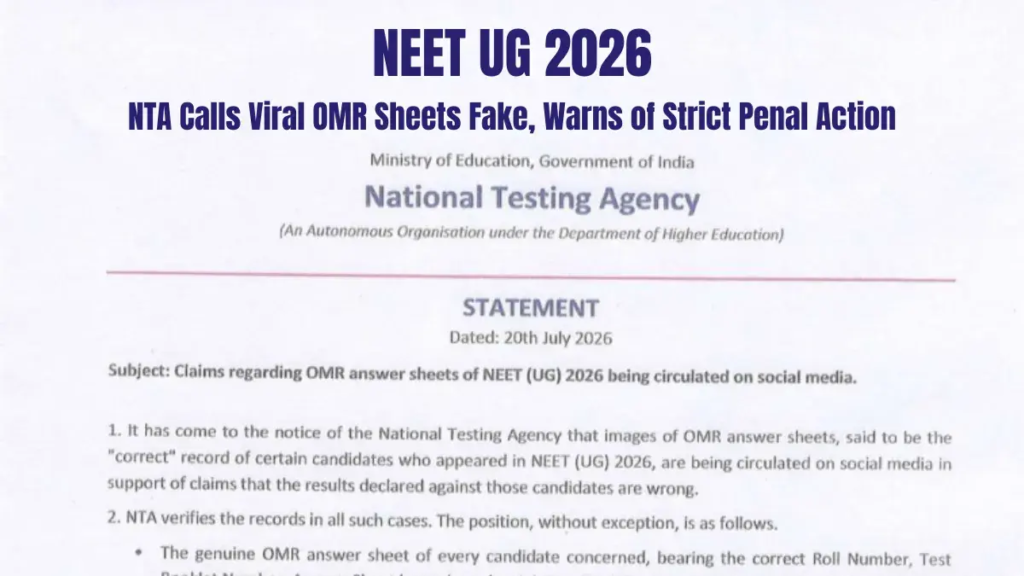
The National Eligibility cum Entrance Test (NEET UG) 2026 has once again become the center of discussion after several Optical Mark Recognition (OMR) sheets went viral on social media. Many students claimed that these OMR sheets proved there were discrepancies in the evaluation process. However, the National Testing Agency (NTA) has firmly denied these claims, stating that the circulating OMR sheets are fake, digitally altered, or AI-generated.
The agency has also warned candidates, parents, coaching institutes, and anyone involved in creating or circulating such documents that strict legal action will be taken if they are found guilty. This development comes at a time when students are already anxious about their results, making it even more important to rely only on official information instead of social media rumors.
Why Did the OMR Sheet Controversy Begin?
Soon after the NEET UG 2026 examination and release of response sheets, several screenshots of alleged OMR sheets started circulating across social media platforms. Some students claimed that the answers shown in the viral images were different from the ones they had marked during the examination.
These posts quickly gained attention, leading many candidates to question whether there had been mistakes in the evaluation process. As the posts spread rapidly, confusion increased among students and parents, with many demanding clarification from the NTA.
NTA Says Viral OMR Sheets Are Fake
In response to the growing controversy, the National Testing Agency released an official clarification stating that the viral OMR sheets being circulated online are not genuine.
According to the agency, its investigation found that many of the documents were:
- Digitally edited
- AI-generated
- Tampered with after downloading
- Shared to create unnecessary confusion
The NTA emphasized that the official OMR sheets stored in its secure database remain the only valid records for evaluation. Any screenshots or edited copies circulating online should not be considered authentic.
Strict Legal Action Against Fake OMR Creators
The NTA has taken a serious stand against misinformation related to NEET UG 2026. It warned that anyone creating, modifying, or sharing fake OMR sheets may face legal consequences.
The agency stated that such actions may attract penalties under the Public Examinations (Prevention of Unfair Means) Act, 2024, along with provisions of the Information Technology Act and other applicable laws.
Importantly, the warning is not limited to students alone. Parents, coaching institutes, and third parties involved in spreading manipulated documents may also be held accountable if found guilty.
How Does NTA Verify OMR Sheets?
Every NEET candidate’s response sheet is securely stored in the NTA’s official database immediately after the examination.
These records include:
- Candidate details
- Question-wise responses
- Time-stamped digital records
- Scanned answer sheets
Whenever a grievance is raised, the agency cross-checks the complaint with these original records rather than relying on screenshots or edited copies shared online.
This verification process helps ensure that genuine complaints are investigated while fabricated documents can be identified quickly.
What Should Students Do If They Notice a Genuine Issue?
The NTA has clarified that students with genuine concerns should continue using the official grievance mechanism.
Instead of posting complaints on social media, candidates should:
- Compare their response sheet carefully.
- Download documents only from the official NEET website.
- Submit grievances through official channels.
- Preserve original records and registration details.
- Avoid editing or modifying downloaded documents.
Following the proper process ensures that genuine issues receive appropriate attention without creating unnecessary confusion.
Social Media Rumors Can Mislead Students
Experts believe that during major entrance examinations, misinformation spreads very quickly through WhatsApp groups, Telegram channels, Instagram pages, and X (formerly Twitter).
Many students unknowingly trust screenshots without verifying their authenticity. This can increase stress levels and create panic among candidates who are already anxious about their results.
The NTA has therefore advised candidates to trust only information published on its official website and verified announcements.
Why Is the Issue So Serious?
NEET UG is India’s largest medical entrance examination, with millions of candidates appearing every year. Even a small rumor can create nationwide panic.
Fake OMR sheets not only spread misinformation but can also:
- Damage the credibility of the examination process.
- Increase unnecessary anxiety among students.
- Waste the time of investigating authorities.
- Delay the resolution of genuine complaints.
This is why the NTA has adopted a strict approach against digital manipulation and fake evidence.
Tips for NEET UG 2026 Candidates
To stay safe from misinformation, students should:
- Download OMR sheets only from the official NEET portal.
- Ignore edited screenshots circulating on social media.
- Verify every update through the NTA website.
- Never forward unverified documents.
- Report suspicious content instead of sharing it.
These simple precautions can prevent unnecessary confusion and help candidates focus on official updates.
What Happens Next?
The NTA has assured students that every genuine complaint will be examined fairly using official records. At the same time, it has made it clear that fabricated or AI-generated OMR sheets will not be tolerated.
Candidates are advised to remain patient, avoid believing social media rumors, and wait for verified announcements. As the admission process continues, relying on authentic information will help students make informed decisions without unnecessary stress.
Conclusion
The recent controversy surrounding viral NEET UG 2026 OMR sheets highlights how quickly misinformation can spread during major examinations. While social media posts created confusion among candidates, the National Testing Agency has categorically stated that many of the circulated OMR sheets are fake, digitally altered, or AI-generated.
Students should avoid trusting unofficial screenshots and instead depend only on authentic information available through the official NTA portal. Genuine grievances can still be submitted through the prescribed process, but sharing manipulated documents may result in serious legal consequences. Staying informed through official sources remains the safest approach for every NEET aspirant.
Book your Free consultancy: 9350777177 / https://reliablestudy.com/
– Content Writer and SEO – Riya Singh
All right reserved – Reliable Study / https://reliablestudy.com/
FAQs
Because investigations found that several circulating OMR sheets were digitally edited or AI-generated and did not match official records.
Yes. NTA has warned that creating or circulating fake OMR sheets may invite legal action under relevant laws.
Students should download their official OMR sheet only from the official NEET/NTA website.
They should submit their grievance through the official NTA grievance mechanism with original documents.
No. Students should rely only on official information released by the NTA.