
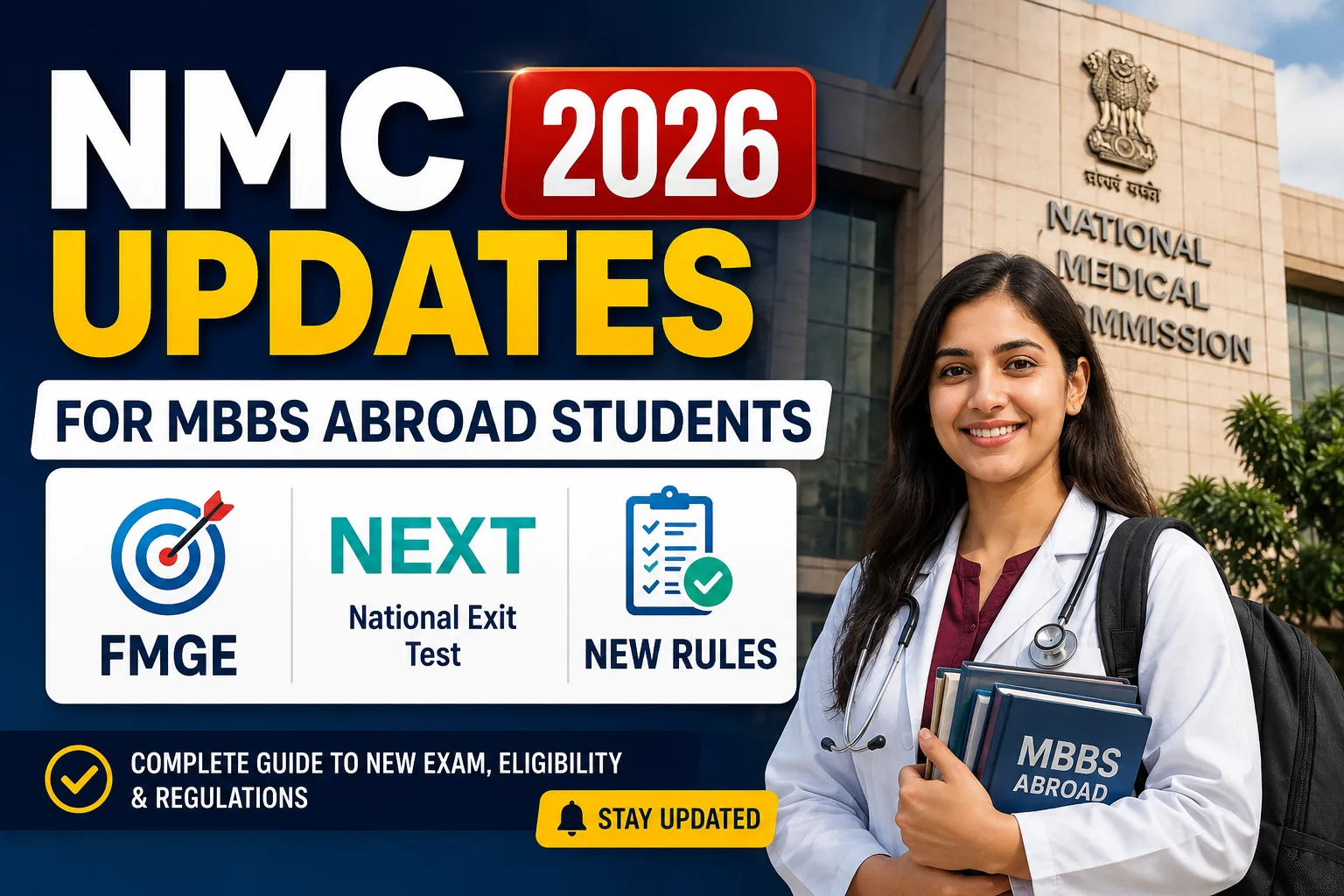
MBBS Abroad 2026: What Has Changed for Indian Students?
For Indian students planning to study MBBS abroad, choosing the right medical university is no longer only about fees, location or admission availability. Regulatory compliance has become equally important.
In 2026, the National Medical Commission (NMC) has issued several important clarifications concerning Foreign Medical Graduates (FMGs), including students who completed part of their medical education through online classes during the COVID-19 pandemic and other disruptions.
At the same time, Indian students have been advised to be extremely careful while selecting foreign medical universities. The NMC has raised concerns about certain institutions in Uzbekistan over regulatory compliance, admission practices and clinical training.
These developments make it important for MBBS Abroad 2026 aspirants to understand the rules before paying fees or confirming admission.
NMC Warns Students About Foreign Medical Universities
One of the major developments related to MBBS Abroad 2026 is the NMC’s caution regarding certain medical institutions in Uzbekistan.
The regulator raised concerns after receiving inputs about irregularities and possible violations of the Foreign Medical Graduate Licentiate (FMGL) Regulations, 2021. Students were advised to verify the credentials, course structure, clinical training and regulatory compliance of a university before taking admission.
This is particularly important because completing an MBBS degree abroad does not automatically guarantee the right to practise medicine in India.
A student must meet the applicable Indian regulatory requirements after completing the foreign medical course.
Why NMC Compliance Matters for MBBS Abroad
The biggest mistake students can make is selecting a university simply because its tuition fee is low.
Before choosing an overseas medical university, students should carefully check:
- Whether the medical programme satisfies applicable NMC requirements
- Course duration and curriculum
- Medium of instruction
- Clinical exposure and hospital training
- Internship requirements
- Eligibility for the applicable screening/licensing process in India
- Whether the university and programme details are genuine and properly documented
The NMC itself states that it does not endorse a specific list of foreign medical institutions or universities for MBBS-equivalent courses. Therefore, students should not rely solely on claims such as “NMC approved university” made by agents or advertisements.
New Clarification on Online MBBS Classes
Another important update concerns students who completed a portion of their medical education online.
During the COVID-19 pandemic and other disruptions, many foreign medical students were unable to attend physical classes and clinical training. The NMC has clarified that medical education completed online cannot simply be treated as equivalent to physical clinical education.
Students affected by online instruction may need to complete appropriate physical onsite compensation training, depending on their circumstances and the applicable regulations.
The NMC has also issued FAQs explaining how compensation training, documentation, internship and registration requirements apply to affected Foreign Medical Graduates.
This highlights an important lesson for current MBBS Abroad 2026 applicants: medical education requires substantial practical and clinical exposure, so students should understand exactly how their university conducts clinical training.
What About Students Who Studied Online During the Pandemic?
The rules can differ depending on when a student was admitted and the circumstances under which online education took place.
According to NMC’s clarification, students admitted on or before November 18, 2021 may fall under the earlier screening-test framework if they satisfy the applicable conditions, including required physical compensation and internship requirements.
Students admitted after that date may come under the applicable CRMI framework and other requirements before registration in India.
Therefore, students who already completed MBBS abroad should not assume that every FMG will follow exactly the same pathway. Their admission date, academic record, clinical training and documentation can affect the applicable process.
FMGE Standards Remain Important
Another important development in September 2026 is the continued emphasis on maintaining qualifying standards for Foreign Medical Graduates.
Recent reporting indicates that the National Board of Examinations has rejected calls to reduce the qualifying standard for FMGs, stressing that the standards should not be diluted.
For students planning MBBS abroad, this means that choosing a foreign medical college should be viewed as a long-term academic decision rather than simply a way to secure a medical seat.
Students should prepare themselves for the licensing requirements applicable after graduation and should select a university where the academic and clinical foundation is strong.
How Should Students Choose an MBBS Abroad University in 2026?
The university selection process should begin with verification rather than fee comparison.
Students and parents should ask the following questions before making a payment:
1. Is the university genuine?
Verify the university’s official name, campus, course and accreditation through reliable official sources.
2. Is clinical training properly structured?
Medical education cannot depend only on classroom lectures. Students need adequate hospital exposure and practical training.
3. What is the complete course structure?
Check the duration, academic years, internship arrangement and clinical rotations before signing admission documents.
4. What documents will the student receive?
Keep admission letters, fee receipts, academic records, internship documents and other certificates safely throughout the course.
5. What are the requirements for returning to India?
Understand the applicable NMC rules and licensing requirements before beginning the programme.
MBBS Abroad 2026: Don’t Choose Only on the Basis of Low Fees
Affordable tuition is one of the major reasons Indian students consider MBBS abroad. However, the cheapest option is not necessarily the safest option.
A university offering a very low fee may look attractive initially, but students should also consider hostel expenses, food, travel, insurance, visa costs, academic expenses and other charges.
More importantly, students should evaluate whether the programme provides the required academic and clinical exposure.
A medical degree is a long-term investment. Saving money at the admission stage should never come at the cost of regulatory compliance or academic quality.
Role of Proper Admission Guidance
With increasing regulatory requirements, professional counselling can help students understand the admission process more clearly.
Reliable Study Education Pvt. Ltd. helps students and parents understand MBBS admission options, university selection, documentation and the overall admission process.
Students should always verify information independently and review the latest applicable NMC requirements before finalising a foreign medical university.
Conclusion
The latest MBBS Abroad 2026 updates show that Indian students need to be more careful than ever while selecting a foreign medical university.
NMC’s recent regulatory clarifications on online medical education, physical compensation training and Foreign Medical Graduate registration, along with its warnings concerning certain foreign institutions, highlight the importance of proper verification.
For students planning to start MBBS abroad in 2026, the right approach is simple: verify the university, understand the course structure, check clinical training, review applicable NMC requirements and avoid making admission decisions only on the basis of low fees.
A well-researched decision at the beginning can help students avoid serious academic and registration-related difficulties later.
Book your free consultancy: 9350777177 / https://reliablestudy.com/
– Content Writer and SEO – Naina Gupta
All rights reserved – Reliable Study / https://reliablestudy.com/
FAQs
It can be, provided the foreign medical graduate meets the applicable NMC regulations and licensing/registration requirements in India.
Indian students generally need to qualify NEET to pursue MBBS or an equivalent medical course abroad under the applicable rules.
FMGL refers to the Foreign Medical Graduate Licentiate regulations governing foreign medical graduates and their pathway toward medical practice in India.
Students should not assume that online medical education will automatically satisfy Indian regulatory requirements. Applicable physical compensation rules must be checked.
Check the university’s credentials, curriculum, clinical training, course duration, documentation and compliance with the applicable NMC requirements before admission.