
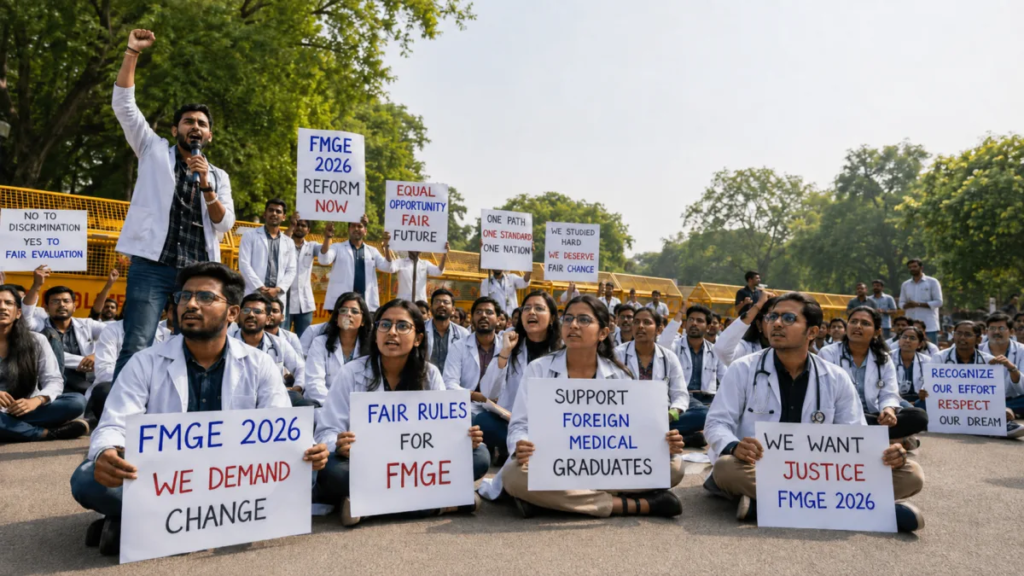
For thousands of foreign medical graduates, the FMGE is more than just an examination. It is the final gateway to fulfilling their dream of practicing medicine in India. Months of preparation, years of education abroad, and significant financial investments all come down to one crucial test.
However, the FMGE June 2026 session has become a topic of intense discussion across the medical student community. Instead of celebrating results and planning their next career steps, many candidates are still waiting for clarity from the National Board of Examinations in Medical Sciences (NBEMS).
The reason? Concerns related to the examination process, technical issues, question patterns, and the long-standing demand for greater transparency in evaluation. Candidates are now urging NBEMS to release the official answer key and response sheets while also providing an update on the committee formed to review their grievances.
What Triggered the Controversy?
The FMGE June 2026 examination was conducted on June 28, and the results were declared on July 7. Like every year, thousands of foreign medical graduates appeared for the licensing examination, hoping to secure eligibility to practice medicine in India.
Soon after the examination, many candidates started raising concerns regarding various aspects of the test. According to student groups and representatives, some candidates experienced technical difficulties during the examination, while others questioned the inclusion and handling of certain video-based questions. There were also concerns about the overall difficulty level of the examination and whether all candidates received a fair testing experience.
As discussions intensified on social media and among student associations, demands for greater transparency became stronger.
Why Are Candidates Asking for the Answer Key?
One of the biggest demands from candidates is the release of the official answer key and response sheets.
Students argue that access to answer keys is a standard practice in many national-level examinations. It allows candidates to verify their performance, identify possible discrepancies, and gain confidence in the evaluation process.
According to several candidates and student representatives, releasing answer keys would help eliminate confusion and build trust between examinees and the examination authority. They believe that transparency is especially important in a high-stakes examination like FMGE, where a candidate’s future career depends on the result.
Many students have also pointed out that without access to answer sheets or answer keys, they have no practical way to understand how their final scores were calculated.
The Committee Review and Growing Frustration
Following protests and concerns raised by candidates, NBEMS reportedly constituted an independent three-member committee to examine the issues associated with the FMGE June 2026 examination. Candidates welcomed this move and expected a timely update regarding the committee’s findings.
However, according to student representatives, the timeline initially expected for the review has already passed. As a result, candidates are becoming increasingly anxious.
For many aspirants, the issue is not just about marks or results. It is about communication. Students say they want regular updates, clarity about the review process, and assurance that their concerns are being examined seriously.
The absence of an official update has led to growing uncertainty among candidates who are still waiting to understand what conclusions the committee has reached.
Concerns Beyond the Answer Key
The demand for transparency goes beyond the release of answers.
Candidates have raised several additional concerns regarding examination infrastructure and the overall testing experience. Some students reported difficulties related to exam-centre facilities, including inadequate arrangements and challenging environmental conditions.
Others questioned the sudden increase in examination difficulty and sought clarification regarding the evaluation of video-based questions. Student associations have also requested a review of examination fees and have called for appropriate relief measures for candidates who may have been affected by technical or operational issues.
These concerns collectively highlight the need for a more candidate-centric approach in conducting large-scale licensing examinations.
Why Transparency Matters in Medical Licensing Exams
Medical licensing examinations play a crucial role in maintaining healthcare standards. At the same time, these exams directly impact the careers of thousands of aspiring doctors.
Transparency helps build confidence in the system. When candidates understand how scores are calculated and how grievances are handled, they are more likely to trust the outcome, even if the result is not in their favor.
Globally, many examination bodies have adopted mechanisms such as answer-key publication, objection windows, and structured grievance redressal systems. Such measures not only reduce disputes but also improve the credibility of the examination process.
For FMGE candidates, transparency is not being viewed as a privilege—it is being viewed as an essential component of fairness.
The Challenge for NBEMS
While candidates are demanding answer keys, NBEMS has traditionally followed a policy of not releasing examination content, answer sheets, or official answer keys. The FMGE information bulletin also states that requests for sharing examination content, including answer keys and answer sheets, are generally not entertained.
Supporters of this policy argue that maintaining confidentiality protects the integrity of the examination system and prevents misuse of question banks.
However, candidates believe that exceptional circumstances require greater openness and communication. This difference in expectations has become the central point of the ongoing debate.
What Happens Next?
At present, FMGE June 2026 candidates are waiting for a formal update regarding the findings of the review committee and any decisions that may follow.
Whether NBEMS chooses to release additional information or maintains its existing policies, one thing is clear: candidates want their concerns to be heard and addressed transparently.
The outcome of this situation could influence how future FMGE examinations are conducted and how candidate grievances are managed in the years ahead.
For now, thousands of aspiring doctors remain hopeful that the examination authority will provide clarity, strengthen trust, and ensure that every candidate feels confident in the fairness of the process.
Conclusion
The FMGE June 2026 controversy is not merely about answer keys or examination scores. It reflects a larger conversation about accountability, transparency, and trust in high-stakes medical examinations.
As candidates continue to seek answers and NBEMS reviews the concerns raised, the medical education community is closely watching the developments. Whatever the final decision may be, transparent communication and timely action will be essential in maintaining confidence in one of India’s most important medical licensing examinations.
Book your Free consultancy: 9350777177 / https://reliablestudy.com/
– Content Writer and SEO – Riya Singh
All right reserved – Reliable Study / https://reliablestudy.com/
FAQs
Candidates want the release of official answer keys, response sheets, and updates regarding the committee reviewing examination-related concerns.
The FMGE June 2026 examination was conducted on June 28, 2026.
Yes, NBEMS constituted an independent three-member committee to examine concerns raised by candidates.
Traditionally, NBEMS does not release FMGE answer keys or answer sheets due to its confidentiality policy.
Students have highlighted issues related to transparency, video-based questions, technical difficulties, examination-centre facilities, and evaluation clarity.