
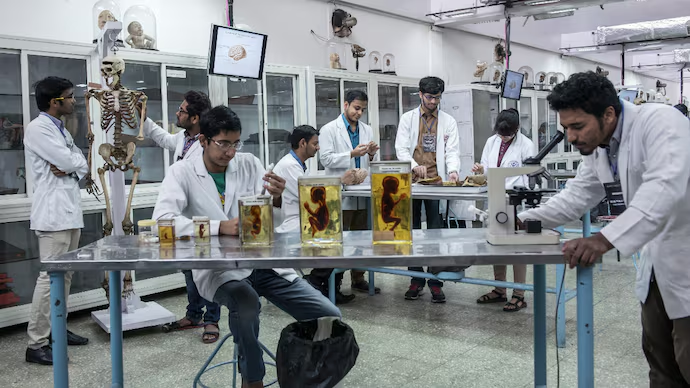
India’s medical education system is one of the largest in the world, producing thousands of doctors every year. However, behind this massive output lies a serious concern that has now been highlighted by a Parliamentary Standing Committee — the lack of uniformity in faculty, student, and patient ratios across medical institutions.
This issue is not just about numbers. It directly affects the quality of doctors being trained, the learning environment in medical colleges, and ultimately the quality of healthcare delivered to patients across the country.
🏥 Why Medical Ratios Matter in Education
In medical education, three key ratios are extremely important:
- 👨🏫 Faculty-to-student ratio
- 🧑🎓 Student-to-patient ratio
- 🏥 Faculty-to-patient exposure balance
These ratios ensure that students get:
- Proper clinical training
- Adequate patient interaction
- Hands-on learning under supervision
- Personalized guidance from teachers
If these ratios are not maintained properly, students may graduate with strong theoretical knowledge but weak practical skills — which can be dangerous in real-world healthcare situations.
⚠️ The Core Problem Identified by the Parliamentary Panel
The Parliamentary Committee has raised concerns that different medical institutions in India follow different standards, especially in:
- Faculty availability
- Student intake capacity
- Patient exposure during training
This means:
- Some colleges have overcrowded classrooms
- Some hospitals have too few patients for training
- Some institutions operate with insufficient teaching staff
- Others may show imbalanced workload distribution
According to official observations on medical education reforms, India already has over 700 medical colleges, but quality varies significantly between institutions due to uneven implementation of standards and infrastructure gaps .
🎓 Impact on Students
When ratios are not uniform, students suffer the most:
1. Reduced Clinical Exposure
Students may not get enough real patient cases to learn practical medicine.
2. Overcrowded Classes
Large batch sizes reduce one-on-one interaction with professors.
3. Unequal Learning Standards
A student from one college may get far better training than another in a different institution.
4. Skill Gaps After Graduation
This leads to variations in confidence and competence among new doctors.
🏥 Impact on Patients and Healthcare System
The issue is not limited to education — it affects the entire healthcare ecosystem.
If doctors are trained in inconsistent environments:
- Diagnosis skills may vary
- Clinical decision-making may differ
- Patient care quality becomes uneven across regions
This is especially critical in a country like India where there is already a high demand for doctors in rural and semi-urban areas.
📊 What the Parliamentary Committee Wants
The Parliamentary Standing Committee has emphasized the need for:
✔️ Uniform Standards Across Institutions
All medical colleges should follow consistent norms for:
- Faculty strength
- Student intake
- Patient exposure
✔️ Strong Monitoring System
Regular inspections to ensure colleges do not manipulate attendance, staffing, or patient records.
✔️ Better Implementation of Regulations
Even though frameworks exist, implementation remains inconsistent across states and institutions.
✔️ Zone-Based Quality Mentoring
Reputed institutes may guide others to maintain standards across regions (as suggested in broader reforms of medical education quality) .
🧑⚕️ Faculty Shortage: A Hidden Challenge
One of the major reasons behind imbalance in ratios is the shortage of qualified faculty members.
Issues include:
- Lack of trained professors
- Poor incentives for teaching careers
- “Ghost faculty” problems in some institutions
- Administrative burden on existing teachers
The committee has repeatedly emphasized that improving faculty quality and availability is essential for fixing the entire system.
Without strong faculty:
- Student training becomes weak
- Clinical supervision becomes inadequate
- Ratios become meaningless on paper
🏥 Unequal Patient Exposure Across Colleges
Another major challenge is uneven patient availability in teaching hospitals.
- Some hospitals are overcrowded
- Others do not have enough clinical cases
- Rural colleges often face different challenges than urban ones
This creates an imbalance in clinical training opportunities, which is why a uniform patient exposure model is being recommended.
🌍 Why Uniformity Is Difficult in India
India’s medical education system is extremely diverse:
- Government vs private colleges
- Urban vs rural institutions
- Old vs newly established colleges
- Different state-level regulations
Because of this diversity, implementing one rigid model is challenging. However, the committee suggests that flexibility should exist only in structure — not in quality standards.
🚀 The Way Forward
To improve the system, India needs:
🔹 Standardized Ratio Guidelines
A national-level benchmark for faculty, students, and patient exposure.
🔹 Real-Time Monitoring Systems
Digital tracking of attendance, faculty presence, and clinical training.
🔹 Stronger Accreditation System
Only institutions maintaining proper standards should receive approvals.
🔹 Investment in Faculty Training
Teachers must be trained not only in medicine but also in teaching methods.
🔹 Better Infrastructure in Hospitals
More clinical cases and improved hospital facilities for training.
🧾 Conclusion
The Parliamentary Committee’s concern highlights a simple truth:
👉 Medical education is not just about increasing seats — it is about improving quality.
Without uniform faculty–student–patient ratios:
- Doctors may graduate with uneven skills
- Patient care quality may vary widely
- The healthcare system may face long-term challenges
India’s goal should not only be to produce more doctors, but to produce better, well-trained, and clinically competent doctors.
Fixing these ratios is not just an administrative reform — it is a step toward building a stronger, safer, and more reliable healthcare future for the country.