
The Cockroach chapter is one of the most scoring topics in Structural Organisation in Animals for NEET Biology. Every year, direct and conceptual questions are asked from its external morphology, digestive system, respiratory system, reproductive system, and important NCERT facts.
Many students ignore this chapter because it seems lengthy. However, with the right approach, Cockroach can become one of the easiest chapters to master. Understanding the body structure, organs, and their functions makes revision much easier before the examination.
In this article, you’ll learn the entire Cockroach chapter in a simple and exam-oriented manner. The topic covers external morphology, internal anatomy, important diagrams, and frequently asked NEET concepts.
What is a Cockroach?
The scientific name of the common cockroach is Periplaneta americana. It belongs to the phylum Arthropoda and is among the oldest surviving insects on Earth.
Classification
- Kingdom – Animalia
- Phylum – Arthropoda
- Class – Insecta
- Order – Blattodea (older texts may mention Dictyoptera)
- Family – Blattidae
- Genus – Periplaneta
- Species – americana
External Morphology of Cockroach
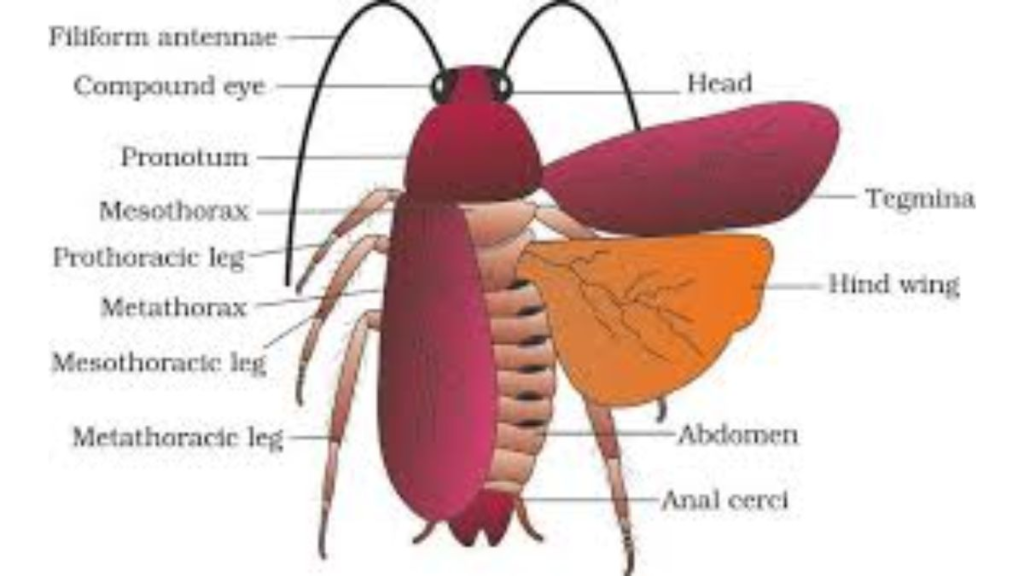
The cockroach has an elongated, dorsoventrally flattened body covered with a hard exoskeleton made of chitin. This protective covering prevents water loss and provides support for muscle attachment.
Its body is divided into three major regions:
- Head
- Thorax
- Abdomen
The reddish-brown colour and segmented body help students identify important structures in NCERT diagrams.
Head Region
The head is triangular and highly flexible.
It contains:
- One pair of antennae
- One pair of compound eyes
- Mouth parts
Compound Eyes
Each compound eye contains nearly 2,000 ommatidia, producing mosaic vision, which allows the cockroach to detect movement efficiently.
Mouth Parts
Cockroach possesses biting and chewing type mouthparts consisting of:
- Labrum
- Mandibles
- Maxillae
- Labium
- Hypopharynx
This is one of the most frequently asked NEET concepts.
Thorax
The thorax consists of three segments:
- Prothorax
- Mesothorax
- Metathorax
Each segment bears one pair of legs.
Therefore, a cockroach has three pairs of walking legs.
The thorax also carries two pairs of wings:
Fore Wings (Tegmina)
- Thick
- Leathery
- Protective
Hind Wings
- Thin
- Transparent
- Used for flying
Abdomen
The abdomen consists of 10 segments.
Some important structures include:
- Anal cerci
- Anal styles (only in males)
- Genital opening
These differences help distinguish male and female cockroaches in examinations.
Internal Anatomy of Cockroach
Understanding the organ systems is essential for scoring well in NEET.
Digestive System
The alimentary canal is divided into:
Foregut
Includes:
- Mouth
- Pharynx
- Oesophagus
- Crop
- Gizzard
The crop stores food, while the gizzard grinds it.
Midgut
The midgut performs digestion and absorption.
Gastric caeca release digestive enzymes.
Hindgut
The hindgut absorbs water and opens outside through the anus.
Respiratory System
Cockroaches breathe through a network of tracheae.
Air enters through 10 pairs of spiracles located along the body.
Oxygen directly reaches tissues through the tracheal tubes.
No lungs are present.
Gas exchange occurs by diffusion.
Circulatory System
Cockroach possesses an open circulatory system.
Important features include:
- Colourless haemolymph
- Dorsal tubular heart
- Haemocoel
Unlike humans, blood does not remain confined within blood vessels.
Excretory System
The excretory organs are Malpighian tubules.
Their functions include:
- Removal of nitrogenous waste
- Conversion into uric acid
Hence, cockroach is called a uricotelic animal.
Nervous System
The nervous system consists of:
- Brain (supra-oesophageal ganglion)
- Ventral nerve cord
- Segmental ganglia
Sense organs include:
- Antennae
- Compound eyes
- Anal cerci
- Maxillary palps
- Labial palps
These organs help detect touch, smell, vibrations, and movement.
Reproductive System
Male Cockroach
Contains:
- Pair of testes
- Vas deferens
- Mushroom gland
- External genitalia (phallomeres)
Female Cockroach
Contains:
- Pair of ovaries
- Oviducts
- Spermatheca
- Genital chamber
Fertilized eggs are enclosed inside an ootheca, which contains multiple eggs.
Important NCERT Facts for NEET
Remember these points carefully:
- Scientific name: Periplaneta americana
- Three pairs of legs
- Two pairs of wings
- Biting and chewing mouthparts
- Open circulatory system
- Tracheal respiration
- Malpighian tubules for excretion
- Mosaic vision
- Uricotelic animal
- Ootheca contains fertilized eggs
These facts frequently appear in objective questions.
Preparation Tips for NEET
To score well in this chapter:
- Read every NCERT line carefully.
- Practice labelled diagrams regularly.
- Memorise scientific terms.
- Revise differences between male and female cockroach.
- Solve previous years’ NEET questions.
- Focus on morphology and organ systems.
Consistent revision will help you answer conceptual as well as direct MCQs with confidence.
Common Mistakes Students Make
Many students lose marks because they:
- Confuse forewings and hindwings.
- Forget the function of Malpighian tubules.
- Mix up anal cerci and anal styles.
- Ignore NCERT diagrams.
- Memorise facts without understanding organ functions.
Avoid these mistakes by revising the chapter multiple times.
Conclusion
Although the Cockroach chapter appears lengthy, it becomes simple when studied systematically. Learning the external morphology first and then moving to internal anatomy creates a strong conceptual foundation.
For NEET aspirants, this chapter offers an excellent opportunity to secure easy marks. Focus on NCERT, revise diagrams regularly, and practice MCQs to strengthen your preparation. With consistent revision, Cockroach can become one of your highest-scoring biology topics.
Book your Free consultancy: 9350777177 / https://reliablestudy.com/
– Content Writer and SEO – Riya Singh
All right reserved – Reliable Study / https://reliablestudy.com/
FAQs
Periplaneta americana.
Malpighian tubules.
An open circulatory system.
Three pairs of legs.
Biting and chewing type mouthparts.