
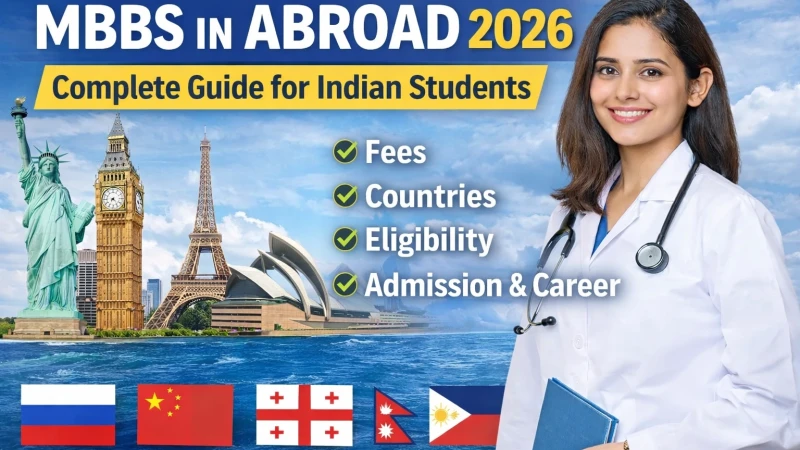
Studying MBBS abroad has become a popular option for Indian students who want to pursue a career in medicine but are unable to secure a government medical seat in India due to intense competition. Every year, thousands of students choose countries like Russia, Kazakhstan, Kyrgyzstan, Georgia, Nepal, and the Philippines for their medical education because of affordable tuition fees and globally recognized universities.
However, before choosing to study medicine abroad, it is very important for students to understand the regulations set by the National Medical Commission (NMC). These rules ensure that Indian students who study medicine abroad can return to India and practice legally after completing their degree.
If a student does not follow these guidelines, they may face serious issues when trying to get medical registration in India. Therefore, every aspiring doctor planning to study MBBS abroad must meet certain requirements.
Below are the most important requirements that Indian students must fulfill before applying for MBBS abroad.
⸻
- Qualifying NEET UG is Mandatory
The first and most important requirement for Indian students who want to study MBBS abroad is to qualify the National Eligibility cum Entrance Test (Undergraduate), commonly known as NEET UG.
The National Medical Commission made it mandatory for all Indian students to qualify NEET before taking admission in any foreign medical university. This rule was introduced to maintain the standard of medical education and ensure that only eligible students pursue medicine.
Why NEET Qualification is Important
Qualifying NEET is not only required for studying medicine in India but also for studying MBBS abroad if the student wants to practice in India later. Without qualifying NEET, a student will not be eligible to appear for the screening exam in India after completing their medical degree abroad.
Even if a foreign university offers admission without NEET, Indian students should avoid taking such admissions because they may not be allowed to practice medicine in India.
Validity of NEET Score
For students studying MBBS abroad, the NEET qualification is generally valid for three years for admission purposes. This means students can use their NEET score within that period to apply to foreign medical universities.
⸻
- Study in an NMC-Approved University
Another very important requirement is that students must study in a medical university that meets the guidelines of the National Medical Commission.
Not all universities abroad are recognized for medical practice in India. Students must ensure that the university they choose follows the NMC regulations and offers a degree that is accepted in India.
How to Check University Recognition
Before applying to any foreign university, students should confirm the following:
• The university is recognized by the country’s medical authority.
• The university follows the medical education standards required by NMC.
• The degree allows students to appear for the screening exam in India.
• The course is taught in English medium.
Many reputable universities in countries such as Russia, Kazakhstan, Kyrgyzstan, Georgia, and the Philippines offer medical programs that meet these requirements.
Choosing the right university is extremely important because selecting an unrecognized institution may result in difficulties when applying for medical registration in India.
⸻
- The Course Must Be Minimum 54 Months Plus Internship
According to the guidelines of the National Medical Commission, the medical course completed abroad must have a minimum duration of 54 months (4.5 years) followed by a mandatory internship.
This requirement ensures that students receive adequate theoretical and clinical training similar to medical students in India.
Structure of the MBBS Course Abroad
Typically, the medical program abroad includes:
Pre-clinical phase
Students study basic subjects such as anatomy, physiology, and biochemistry.
Para-clinical phase
Subjects like pathology, microbiology, and pharmacology are taught.
Clinical phase
Students gain hospital exposure and learn subjects such as medicine, surgery, pediatrics, and gynecology.
After completing the academic portion of the course, students must also complete a clinical internship in a hospital.
This internship provides practical training where students work with patients under supervision, helping them develop essential medical skills.
If the medical program abroad does not include proper clinical training or internship, it may not be accepted by the National Medical Commission.
⸻
- Clearing the Screening Exam in India (FMGE or NEXT)
After completing MBBS abroad, Indian students must pass a screening exam to practice medicine in India. Currently, the exam conducted for foreign medical graduates is the Foreign Medical Graduate Examination (FMGE).
The FMGE is conducted by the National Board of Examinations in Medical Sciences (NBEMS). This exam is mandatory for students who obtained their medical degree from outside India.
Purpose of the Screening Exam
The screening exam ensures that foreign medical graduates possess the necessary knowledge and skills to practice medicine safely in India.
The exam is conducted twice a year and tests students on various medical subjects that are taught during the MBBS program.
After passing this exam, students can apply for provisional or permanent registration with the medical council in India.
Future Replacement by NEXT
In the coming years, the FMGE is expected to be replaced by the National Exit Test (NEXT). This exam will serve as both a licensing exam and a postgraduate entrance test for medical graduates.
Once NEXT is implemented fully, both Indian and foreign medical graduates will have to pass the same exam to practice medicine in India.
⸻
Things Students Should Consider Before Choosing MBBS Abroad
Apart from meeting the official requirements, students should also consider several other factors before deciding to study medicine abroad.
Quality of Education
Students should select universities that have experienced faculty, modern laboratories, and well-equipped teaching hospitals.
Language of Instruction
The course should ideally be taught in English to avoid learning difficulties.
Clinical Exposure
Hospitals affiliated with the university should provide adequate patient exposure for practical training.
Cost of Education
Although studying abroad is generally cheaper than private medical colleges in India, students should still evaluate tuition fees, living expenses, and other costs.
⸻
Conclusion
Studying MBBS abroad can be an excellent opportunity for Indian students who aspire to become doctors but cannot secure a seat in India due to limited availability and high competition.
However, students must carefully follow the guidelines set by the National Medical Commission to ensure that their degree is valid in India.
To summarize, the four most important requirements are:
• Qualifying the National Eligibility cum Entrance Test (Undergraduate) (NEET UG)
• Studying in a university that meets NMC guidelines
• Completing a minimum 54-month medical course plus internship
• Passing the Foreign Medical Graduate Examination or the upcoming National Exit Test
By understanding these requirements and choosing the right university, students can successfully pursue their dream of becoming doctors and practicing medicine in India