
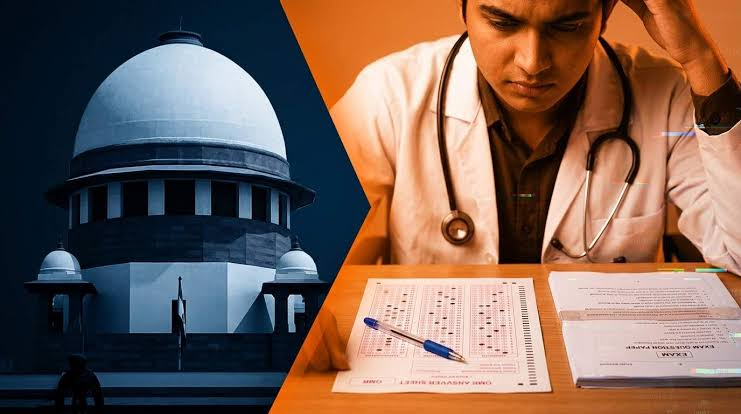
For millions of students across India, NEET UG is more than just an entrance exam—it is the gateway to a career in medicine. Every year, candidates spend months preparing for one of the most competitive examinations in the country. While discussions around NEET often focus on exam patterns, counselling, and cut-offs, a recent Supreme Court hearing has highlighted an issue that many people had never considered before: what happens when a student cannot complete fingerprint-based biometric verification?
The Supreme Court of India has agreed to examine whether alternative methods of identity verification should be made available for NEET candidates who are unable to use fingerprint biometrics because of medical or physical conditions. The matter gained attention after a student suffering from a rare condition called ‘adermatoglyphia’ faced difficulties during the NEET examination when biometric scanners failed to recognise her fingerprints.
Why Has This Issue Reached the Supreme Court?
Biometric verification has become an important part of major competitive examinations in India. Authorities use fingerprint authentication to prevent impersonation and ensure that the registered candidate is the one appearing for the exam.
However, not everyone can successfully complete fingerprint verification.
The case before the Supreme Court involves a candidate who suffers from adermatoglyphia, an extremely rare genetic condition often referred to as the “absence of fingerprints”. Because of this condition, biometric devices are unable to capture or verify fingerprint data accurately. During NEET UG 2025, the candidate reportedly lost valuable examination time while officials attempted to verify her identity through biometric systems.
Recognising the broader implications of the issue, the Supreme Court observed that important questions arise regarding the rights of candidates who cannot undergo fingerprint-based authentication due to genuine medical reasons. The Court has therefore decided to examine the matter in greater detail.
Understanding Adermatoglyphia
Adermatoglyphia is a rare genetic condition in which a person is born without the ridge patterns that form fingerprints. Since fingerprint scanners rely on these unique ridges for identification, people with this condition often face challenges when biometric authentication is mandatory.
Although the condition is extremely uncommon, the issue is not limited to individuals with Adermatoglyphia. There are several situations where biometric verification may fail, including:
- Skin disorders affecting fingerprints
- Injuries or burns on fingers
- Physical disabilities
- Technical scanner failures
- Poor-quality biometric records
This raises an important question: Should a student lose examination time or face difficulties because of a condition beyond their control?
What Is the Supreme Court Examining?
The Supreme Court is not questioning the need for security measures in examinations. Instead, it is examining whether authorities can rely exclusively on fingerprint biometrics when certain candidates are unable to provide fingerprint authentication.
The Court is considering whether alternative identity verification mechanisms can be implemented for genuine cases while maintaining the integrity and security of the examination process.
The discussion is significant because it balances two important objectives:
- Preventing unfair practices and impersonation.
- Ensuring equal opportunities for candidates with disabilities or rare medical conditions.
Possible Alternative Verification Methods
While the final decision is yet to be made, several alternatives are being discussed and considered.
These may include:
1. Aadhaar-Based Verification
Candidates could be verified through Aadhaar-linked details and official identification documents.
2. Facial Recognition
Advanced facial recognition technology may serve as an additional authentication method in cases where fingerprint verification is not possible.
3. Official Certification
Candidates with documented medical conditions could submit certificates issued by competent authorities before the examination.
4. School or Government Verification
Identity verification through school principals, district authorities, or magistrates may be considered for exceptional cases. Reports indicate that alternative identity documents certified by authorized officials have already been discussed in the ongoing matter.
Why This Decision Matters for Future NEET Aspirants
The Supreme Court’s examination of this issue is important because it highlights the need for a more inclusive examination system.
India’s competitive exams are designed for millions of students from diverse backgrounds. While security remains essential, systems must also account for candidates who face genuine physical or medical limitations.
A more flexible verification framework could ensure that:
- No student loses exam time because of authentication issues.
- Candidates with disabilities receive fair treatment.
- Examination authorities maintain security without excluding deserving students.
- Rare medical conditions are properly recognised and accommodated.
For aspiring doctors, fairness during the examination process is just as important as transparency in results and counselling.
What Could Change in NEET UG 2026 and Beyond?
If the Supreme Court ultimately supports alternative verification methods, examination authorities may be required to develop clear guidelines for exceptional cases.
Future NEET candidates could see:
- Special provisions for medically verified conditions.
- Multiple layers of identity verification.
- Faster resolution of biometric failures at examination centres.
- Better training for exam officials handling such situations.
Such changes would not weaken the examination process. Instead, they could make it more accessible and equitable for every deserving student.
Final Thoughts
The ongoing Supreme Court examination of alternative identity verification methods represents a significant step toward inclusivity in India’s examination system. While biometric authentication remains an effective security tool, it may not be suitable for every candidate.
For students affected by rare medical conditions, disabilities, or biometric challenges, this case offers hope that future examinations will recognise their circumstances without compromising fairness or security.
As NEET continues to evolve, the focus should remain on ensuring that every candidate gets an equal opportunity to compete based on knowledge and merit—not on whether a fingerprint scanner can recognise them. The Supreme Court’s observations may ultimately pave the way for a more student-friendly and inclusive examination framework in the years ahead.
Book your Free consultancy: 9350777177 / https://reliablestudy.com/
– Content Writer and SEO – Riya Singh
All right reserved – Reliable Study / https://reliablestudy.com/
FAQs
To ensure students with medical conditions are not disadvantaged during identity verification.
A rare genetic condition where a person is born without fingerprints.
Yes, due to medical conditions, injuries, disabilities, or scanner errors.
Facial recognition, Aadhaar verification, and certified identity documents.
The final decision is still under consideration by the Supreme Court.