
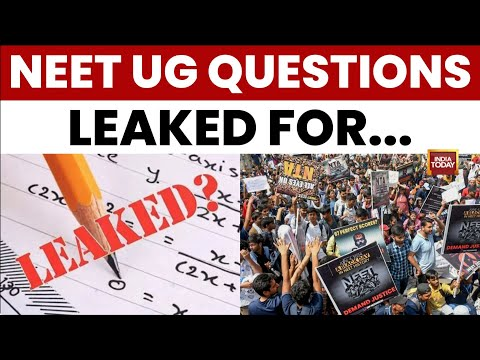
NEET UG 2026 Guess Paper Controversy: What is the Entire Issue About?
India’s biggest medical entrance exam, the NEET UG 2026, once again becomes the centre of discussions, but this time the reason is not the difficulty level or cutoff marks but the issue of the “Guess Paper Controversy”. From social media to coaching groups and even Telegram channels, there have been many claims made saying that the actual questions for the NEET UG 2026 were already present in some “guess papers” beforehand. Following this, the concern of students and parents alike has risen regarding whether there may be any question of impartiality in the upcoming examination.
However, not every viral news report is true. In this case, the most important question to ask would be, ‘Is this a case of paper leakage or a misunderstanding blown out of proportion by social media?’
What is a guess paper, and why did it become so viral?
Before each big competitive exam, a number of coaching institutes and educational platforms release “guess papers”. The main aim behind such papers is to create potential questions by analysing previous years’ trends, syllabus patterns, and topics that may be asked in the exam.
In exams like NEET, thousands of teachers and experts formulate questions on the basis of their analysis of past years’ exams. Often, after solving certain topics or patterns of questions, students feel that the paper was available even before the exam.
However, this time the controversy gained more momentum because some students claimed that there were certain questions which were “almost the same”. Screenshots started spreading virally on social media, and many people tried to connect this issue with a security lapse.
Why is there an increase in fear among students?
NEET is not only an examination but also a pathway for thousands of students’ dreams to come true. Students prepare for NEET through coaching classes and mock exams for several years.
In such a scenario, any kind of controversy can create frustration and fear among students. They start thinking that even if some students have been offered an unfair advantage earlier, what will happen to their efforts?
Students became more sensitive than before due to controversies over exam transparency in the 2024 and 2025 examinations. This is the reason why the Guess Paper controversy has impacted them emotionally too.
Several students expressed on social media that they felt some questions appeared familiar after taking the exam. Whereas, some candidates termed this incident a mere coincidence and stated that good teachers can easily predict examination trends.
Is it unusual for questions to appear on the guess paper?
Not at all.
In competitive exams, coaching institutes have many times released predicted questions which sometimes even get repeated in the actual exam papers, but this doesn’t always mean that there was any paper leak.
There are some big reasons behind this:
- Repeated Topics
The NEET syllabus is limited, and certain topics keep appearing every year. For example, in biology, subjects like genetics, human physiology, and ecology; and in physics, modern physics and current electricity are recurring each year.
- Pattern Analysis
An experienced faculty can conduct an in-depth analysis of the previous years’ papers and create some questions from them.
- Similar Concept, Different Question
Many times, the question isn’t exactly the same, but the concept is similar, making students feel that the paper has been available before.
This is why many experts are not calling it a complete paper leak but simply a case of pattern prediction.
How much did social media exaggerate the case?
In the age of digitalisation, everything becomes viral in minutes. This is precisely what happened in the case of the NEET 2026 controversy too.
Some Telegram channels and YouTube videos have sensational headlines where it was said that “the same paper leak occurred” or “guess the paper came out to be an original paper”.
The problem comes when such information is spread without any verification, causing panic. Students get disturbed mentally, and trust gets diluted.
According to several experts in the field of education, misleading information is most harmful in the matter of exams because the impact of misinformation is directly felt by the students.
Will this affect the credibility of the NEET UG 2026?
This question is highly significant.
If the transparency of an examination becomes subject to repeated questioning, students’ confidence tends to be affected. In national examinations like NEET, transparency should take the topmost priority.
On the other hand, it would not be right to label any examination as questionable based on mere allegations through social media platforms. It is always advisable to analyse any controversial issue concerning evidence-based investigations and statements made by concerned authorities.
Students and parents want the authorities to conduct a thorough inquiry into the matter with complete transparency in order to remove all kinds of ambiguity.
What should students do at this time?
The first and foremost thing that one should do in such controversies is keep their focus intact.
If you have appeared in an exam, then you should not pay attention to any rumours before the results are declared. Rather, it will be much more practical to concentrate on your next course of action.
Those students who are preparing for their next attempt should understand that guess papers only serve as practice material but do not guarantee success.
Preparation always requires hard work and practice based on concepts and revision.
Does the whole controversy teach some great lessons?
Absolutely.
The whole matter is a lesson for all three: students, the coaching industry, and examination authorities.
The former should not place complete faith in any viral information.
The latter two need to be more responsible and more communicative, respectively.
But what is most important of all is the fact that the greatest strength of any competitive examination lies in the trust placed by the students in the system.
As long as the trust persists, so will the system.
Conclusion
The NEET UG 2026 Guess Paper fiasco may have definitely put lakhs of students into trouble, but still there are many questions to be answered. Was this all just a matter of smart predictions? Did the coincidences get exaggerated unnecessarily? Or is an in-depth investigation really needed here?
Only time can answer these questions.
But one thing is for sure: the effort put in by any student always pays off, and it’s the responsibility of the whole exam system to do justice to their efforts.
Book your Free Consultancy :- 9350777177 / https://reliablestudy.com/
–Content Writer and SEO – Riya Singh
All right reserved – Reliable Study / https://reliablestudy.com/
FAQ’S
The controversy started after claims surfaced that some questions in NEET UG 2026 were similar to those in pre-exam guess papers shared by coaching institutes and online platforms.
Not necessarily. Similar questions in guess papers do not automatically confirm a paper leak. Experts say it could also be due to syllabus trends and exam pattern predictions.
Many students are worried because NEET is a highly competitive exam, and any suspicion of unfair advantage can affect trust in the examination process.
Yes, to some extent. Experienced teachers often analyze previous years’ patterns and important topics to create likely questions, which may sometimes match the actual exam.
To date, there has been no official indication that the controversy will have any effect on results. Any decision would be based on findings of authorities or investigations.