
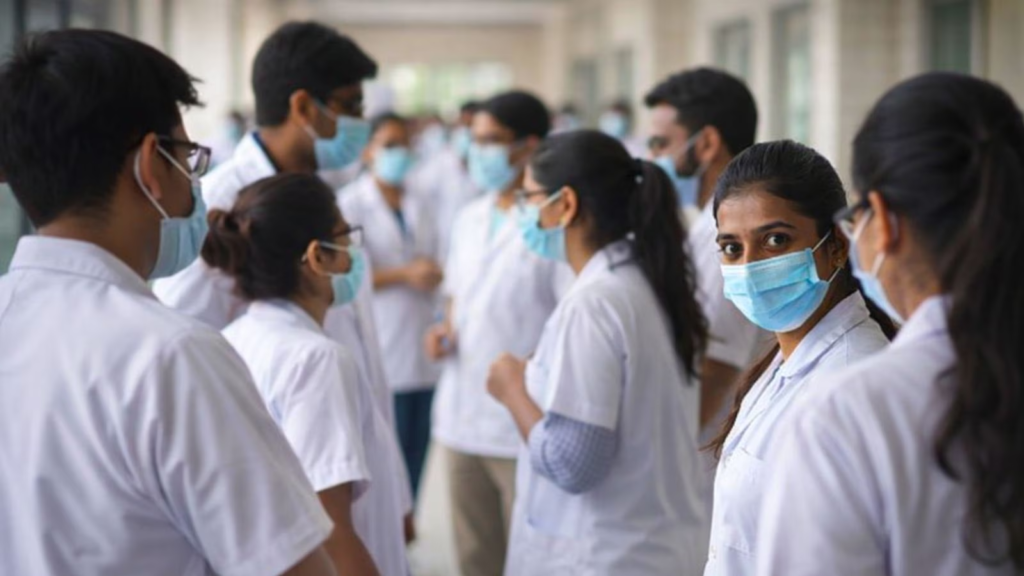
The Centre has recently shared new figures highlighting a significant expansion in medical education across India. In a written reply to the Rajya Sabha on March 10, Union Minister of State for Health and Family Welfare Anupriya Patel revealed that 43 new medical colleges have been established for the 2025–26 academic year. Along with these, a total of 11,682 MBBS seats and 8,967 postgraduate seats have been approved nationwide — making it 20,649 new medical seats altogether.
The ministry clarified that the postgraduate seats include those in AIIMS and other Institutes of National Importance. This expansion follows the government’s strategic plan: linking new medical colleges with existing district or referral hospitals and using the initiative to address regional imbalances in medical education.
Under the centrally sponsored scheme, 157 medical colleges have been approved so far, at a total cost of ₹41,332.41 crore. Out of this, ₹23,246.10 crore has already been disbursed from the government’s share of ₹26,715.84 crore, the ministry added.
The underlying focus of this initiative is clear and politically significant: bringing quality medical education to underserved areas, aspirational districts, and regions that have long had limited access to medical colleges. This approach not only increases the number of doctors but also aims to reduce regional disparities in healthcare and strengthen the country’s medical infrastructure.
While creating new medical seats makes for a positive headline, the reality is more complicated once the initial excitement fades. Despite the government steadily adding capacity, a significant number of postgraduate medical seats remain unfilled. This isn’t just a one-off issue — Rajya Sabha data shows thousands of PG seats have stayed vacant over the years.
To prevent these seats from going unused, authorities have had to lower the NEET PG qualifying percentile sharply, highlighting a deeper structural challenge.
This is the paradox confronting the system today: India is showcasing a massive expansion of medical education, yet a part of this growth is not attracting enough candidates without continuously easing the entry criteria. As a result, the real question has shifted from “How many seats have been created?” to “Why are so many postgraduate medical seats still going vacant?”
This gap points to broader issues in medical education, including career incentives, regional disparities, and the attractiveness of certain specialties, which need urgent attention alongside the expansion effort.
India’s NEET PG seat curve takes a sharp upward turn
India’s NEET PG seat curve takes a sharp upward turn
Data presented in the Rajya Sabha in February 2026 by Patel shows that the story of postgraduate medical seat expansion over the last five years has not been one of calm, steady growth. It has moved in jolts.
| INDIA’S MEDICAL SEAT EXPANSION: A SNAPSHOT | ||
| Academic year | NEET UG seats added | NEET PG seats added |
| 2021–22 | 8,790 | 4,705 |
| 2022–23 | 7,398 | 2,874 |
| 2023–24 | 9,652 | 4,713 |
| 2024–25 | 8,641 | 4,186 |
| 2025–26 | 11,682 | 8,416 |
Source: Data presented by the Minister of State for Health and Family Welfare in Rajya Sabha, February 2026
In 2021–22, the increase stood at 4,705 seats. A year later, it dropped sharply to 2,874. It climbed back to 4,713 in 2023–24, slipped again to 4,186 in 2024–25, and then suddenly shot up to 8,416 in 2025–26.
The latest numbers change the perspective on the trend in medical education. For several years, the expansion of postgraduate (PG) seats had been modest, staying below the 5,000-seat mark, with growth moving forward slowly, then stumbling, recovering, and losing momentum again. But in 2025–26, the story took a sharp turn: 8,416 PG seats were added in a single year. This isn’t just the highest increase in recent years — it’s almost double the previous year’s addition. Instead of incremental growth, this represents a visible shift in scale for postgraduate medical education.
This is especially significant because NEET PG represents the more critical end of medical education. While MBBS seats widen access to medicine, PG seats shape the specialist pipeline — determining how many trained doctors advance into specialized fields, teaching positions, and higher-level institutional care. A sudden leap in PG seats suggests that the system is making a concentrated effort to expand capacity at the specialist level, where growth has historically been uneven and slower.
By comparison, the undergraduate (UG) trend appears steadier. MBBS seat additions over the last few years show minor fluctuations:
- 2021–22: 8,790 seats
- 2022–23: 7,398 seats
- 2023–24: 9,652 seats
- 2024–25: 8,641 seats
- 2025–26: 11,682 seats
The UG expansion remains strong and politically visible, steadily rising over time. But this year, it’s the PG curve that truly stands out. While the undergraduate line rises steadily, the postgraduate line doesn’t just climb — it leaps, highlighting the government’s push to strengthen specialist medical training at a much larger scale than before.
NEET PG: The problem of increasing seats and rising vacancies
A temporary problem is supposed to leave after making a mess. The issue of vacant seats in India’s postgraduate medical education seems to have unpacked its bags.
| VACANT MEDICAL SEATS IN INDIA: A FOUR-YEAR SNAPSHOT | ||
| Academic year | Vacant UG seats | Vacant PG seats |
| 2021–22 | 141 | 3,744 |
| 2022–23 | 2,027 | 4,400 |
| 2023–24 | 490 | 3,028 |
| 2024–25 | 380 | 2,849 |
Source: Data presented by the Minister of State for Health and Family Welfare in Rajya Sabha, February 2026
For four consecutive academic years, a significant number of NEET PG seats have remained vacant, and the figures are too large to ignore and too consistent to treat as an exception. The vacancies stood at 3,744 in 2021–22 and increased to 4,400 in 2022–23. There was a slight improvement afterward, with 3,028 seats vacant in 2023–24 and 2,849 in 2024–25.
However, this recovery is hardly reassuring. A system that still leaves nearly three thousand postgraduate seats unfilled is not facing just a minor counselling glitch — it is exposing a deeper structural issue.
The government may be producing more seats, but a significant portion is not attracting candidates. The seats exist on paper, but they are not aligned with students’ aspirations.
The contrast becomes even clearer when compared to undergraduate (UG) seats. UG vacancies were only 141 in 2021–22, spiked to 2,027 in 2022–23, but then fell sharply to 490 in 2023–24 and 380 in 2024–25. The undergraduate curve, while bruised by fluctuations, shows signs of self-correction.
The postgraduate curve, on the other hand, does not. Here, the system isn’t just struggling to fill seats — it is struggling to make enough of them feel worth taking. This highlights that while access to medical education is expanding, the appeal and relevance of certain PG programs remain a critical challenge.
Why young doctors are walking past NEET PG seats
The issue of vacant PG medical seats is not simply a matter of students being unwilling. According to Dr. Rohan Krishnan, Chief Patron of the Federation of All India Medical Association, the vacancy trend points to something far more serious. He puts it plainly:
“Vacant seats are a symptom of systemic dysfunction, not student apathy.”
Dr. Krishnan explains that the dysfunction starts with how seats are being created. “Seats have been added rapidly without ensuring adequate faculty strength, patient load, clinical exposure, and teaching infrastructure,” he says. These are critical elements for postgraduate medical training, and their absence makes it difficult for students to have meaningful learning experiences.
The second major issue is where these seats are located and the kind of institutional environment they offer. “Many vacant seats are concentrated in remote or underserved regions, in institutions that offer erratic stipends, excessive workload, inadequate safety, and weak academic culture,” Dr. Krishnan observes. “Young doctors are not avoiding service — they are avoiding exploitative and unsafe training environments.”
He also highlights the deterrent effect of state bond policies. “Long compulsory service periods, financial penalties running into lakhs, and unclear enforcement mechanisms discourage candidates, particularly those from modest backgrounds, from accepting seats that could trap them in prolonged or uncertain obligations,” he says.
Adding to these challenges are multiple rounds of counselling, last-minute rule changes, and poor coordination between states. “All of these factors result in candidates losing eligibility, seats remaining blocked until late rounds, and very little practical opportunity for relocation,” Dr. Krishnan notes.
Taken together, these issues make it clear that the problem of vacant PG seats is structural, rather than a simple question of student willingness. Addressing it requires not just adding more seats, but ensuring quality, safety, and accessibility in postgraduate medical training across the country.
Conclusion
In the end, the NEET PG vacancy story is not about a few leftover seats after counselling. The problem is not one of dwindling aspiration, but of value creation. Adding more seats to boost higher education in medicine is an achievement for sure, but only if those seats offer the kind of reliability that aspirants find good enough to go for. A seat existing in theory and government documents cannot make it worthwhile. Policymakers need to stop treating the empty PG seats as temporary embarrassment that can be covered up by the easiest shortcut: Percentile reduction. They need to acknowledge and address the hard truths behind this systemic failure to make medical specialization in India a worthy pursuit.