
The students of Class IX currently study two languages, mathematics, science and social science
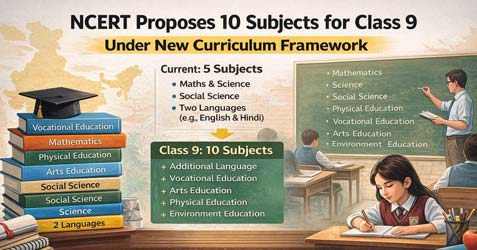
The NCERT, the apex body for preparation of syllabus and school textbooks, wants Class IX students to study 10 subjects, double of what they do now.
The students of Class IX currently study two languages, mathematics, science and social science.
According to the draft syllabus for Class IX uploaded by NCERT on its official website, students may soon study one additional language along with four new subjects. These new subjects include Individuals in Society, Vocational Education, Arts Education, and Physical Education and Well-being.
NCERT has also clarified that most of these subjects will continue in Class X, but “Individuals in Society” will be replaced with Environmental Education in the next grade.
The proposed changes have received mixed reactions. Two school principals who spoke to The Telegraph expressed concern that introducing these additional subjects could increase the academic load on students. However, an education expert welcomed the move, saying it could help students gain broader knowledge and practical skills.
The draft syllabus refers to the National Curriculum Framework for School Education (NCF-SE) 2023, which recommended the inclusion of these new subjects in the curriculum. NCERT is currently preparing new textbooks for Class IX, which are expected to be released by the end of March.
According to the draft, NCF-SE 2023 also emphasizes the three-language formula, requiring students to learn three languages from Classes VI to X. At present, most students study their mother tongue, English, and another Indian language up to Class VIII.
A principal of a private school said that schools cannot implement the draft syllabus immediately. According to her, any changes will only be adopted after the respective school boards, such as CBSE, officially direct schools to follow them. She also pointed out that these new subjects are not part of undergraduate entrance exams, which means students might end up studying them mainly to pass school assessments rather than for competitive exams.
Another school principal also expressed concern that the NCERT’s draft syllabus goes against the objective of the National Education Policy (NEP), which had recommended reducing the academic burden on students. According to her, introducing additional subjects could increase the overall study load.
She further explained that many schools in northern states are likely to introduce Sanskrit as the additional language, which could make the curriculum even more demanding for students.
However, Ramesh Ghanta, a retired professor at Maulana Azad National Urdu University and former member of the National Council for Teacher Education, welcomed NCERT’s decision to include a wider range of subjects. He believes that such subjects can help students develop practical skills and a broader understanding of society.
According to Ghanta, the true purpose of education is to develop responsible and capable citizens. In a rapidly changing world, education must also evolve to equip students with the right knowledge and life skills. Subjects like vocational education, physical education, arts education, and environmental education can play an important role in improving students’ personality development and practical abilities.
However, he also pointed out that the success of these changes will largely depend on the preparedness of teachers. At present, many government schools face a shortage of teachers, and existing teachers may not have the required training to teach these new subjects effectively.
He emphasized that proper training and preparation for teachers should be ensured before these subjects are formally introduced into the curriculum.