
The JEE Main examination has always been one of the most competitive entrance exams in India, acting as the gateway to top engineering institutes like NITs, IIITs, and GFTIs. Every year, lakhs of students appear for this exam with the dream of securing a high rank and a better college.
But this year, something important has changed.
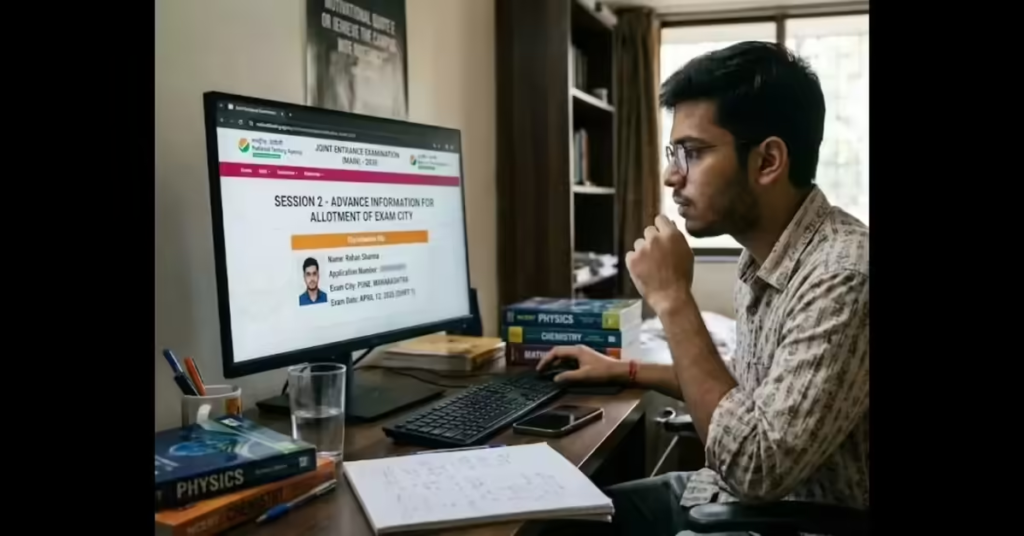
The JEE Main 2026 Session 2 has introduced a new concept being widely discussed as “Rank Optimisation Mode”, which is reshaping how students approach the exam. Instead of treating each session as a one-time opportunity, students are now focusing on strategic improvement, score maximisation, and rank enhancement across sessions.
This shift is not just technical—it is changing the mindset, preparation strategy, and even career planning of engineering aspirants.
What is “Rank Optimisation Mode” in JEE Main?
Traditionally, students treated JEE Main Session 1 and Session 2 as separate attempts, with the final rank based on the best score out of both sessions.
However, the new approach being observed in 2026 focuses on rank optimisation, meaning:
- Students aim to improve their performance strategically in Session 2
- Focus is not just on passing or qualifying, but on maximising percentile gains
- Every mark is now seen as a rank-shifting opportunity
In simple words, students are no longer just attempting the exam—they are playing a calculated game of improvement and optimisation.
Why This Shift Matters for Students
This change is significant because it affects how students prepare, revise, and even select their attempt strategy.
Earlier, many students:
- Treated Session 1 as a trial exam
- Focused heavily on JEE Advanced after one attempt
- Did not fully utilise the second attempt strategically
Now, with rank optimisation mindset, students are:
- Analysing Session 1 mistakes deeply
- Focusing on weak topics improvement
- Using mock tests more strategically
- Planning Session 2 as a rank booster rather than backup attempt
This is making the competition more data-driven and strategy-focused than ever before.
JEE Main 2026: A Shift Toward Smarter Competition
The National Testing Agency (NTA) conducts JEE Main twice a year. The final ranking system already considers the best percentile score from both sessions.
But the 2026 trend shows something new:
- Students are not randomly attempting both sessions
- They are planning improvement cycles between sessions
- Coaching institutes are building “Session 1 to Session 2 improvement modules”
- Mock test strategies now simulate rank optimisation scenarios
This shows that JEE Main is evolving from a single exam challenge into a multi-stage performance system.
How Students Are Changing Their Preparation Strategy
With the rise of rank optimisation thinking, preparation methods have also changed significantly.
📌 1. Error analysis is now critical
Students are spending more time reviewing:
- Wrong answers
- Time-consuming questions
- Conceptual weak areas
Instead of just solving new questions, they are fixing old mistakes first.
📌 2. Focus on high-weightage topics
Students are prioritising topics like:
- Modern Physics
- Coordination Chemistry
- Calculus
- Electrostatics
- Organic reaction mechanisms
These topics are known to be rank-deciding areas.
📌 3. Mock tests with ranking simulation
Now mock tests are not just practice—they are used to:
- Predict percentile
- Estimate rank range
- Improve speed under pressure
Many coaching institutes are introducing AI-based performance tracking systems.
📌 4. Session 2 = improvement opportunity
Instead of treating Session 2 as a second chance, students now see it as:
- A performance upgrade round
- A chance to increase percentile significantly
- A way to secure better college options
Impact on Engineering Aspirations
This shift is also changing how students think about engineering admissions.
Earlier, students aimed simply for:
- Qualifying JEE Advanced
- Getting into any NIT or IIIT
Now, aspirants are more focused on:
- Top NIT branches (CSE, ECE)
- Tier-1 IIITs
- High ROI engineering colleges
- Better branch + better location combination
This is making engineering admissions more competitive and selective.
Coaching Institutes Also Adapting Fast
Coaching institutes across India are quickly adjusting their teaching models.
They are now offering:
- Rank improvement workshops
- Session 2 crash courses
- Strategy-based revision plans
- Personalized weak-area mapping
Institutes are no longer focusing only on syllabus completion—they are focusing on rank improvement techniques.
Advantages of Rank Optimisation Approach
This new trend brings several benefits:
✅ Better performance awareness
Students understand exactly where they stand.
✅ Improved preparation quality
Focus shifts from quantity to quality of preparation.
✅ Higher motivation between sessions
Students stay engaged after Session 1 results.
✅ Smarter exam strategy
Time management and question selection become more refined.
Challenges Students May Face
However, this approach also brings challenges:
⚠️ Pressure to constantly improve
Students may feel mental stress to increase percentile.
⚠️ Over-analysis of performance
Too much data tracking can lead to confusion.
⚠️ Coaching dependency
Students may rely heavily on strategy tools rather than concepts.
Balancing strategy with strong fundamentals remains essential.
What Experts Suggest
Education experts believe that while rank optimisation is helpful, students should not forget the basics:
- Strong conceptual clarity is still the foundation
- Regular revision is more important than strategy alone
- Mock tests should not replace real understanding
- Mental health must be prioritised during preparation
Experts recommend a balanced approach of strategy + fundamentals.
Conclusion
The introduction of the “Rank Optimisation Mode” in JEE Main Session 2 2026 marks a major shift in how engineering aspirants prepare for one of India’s toughest exams.
It reflects a new era where success is not just about hard work, but also about smart planning, data-driven preparation, and continuous improvement.
Students who adapt to this new system early are likely to gain a significant advantage in securing better ranks and top engineering seats.
In the end, JEE Main is no longer just an exam—it is becoming a strategic performance journey, where every attempt is a step toward perfection.